

Wire an agent into your enterprise systems through MCP, give it a search tool, and ask it to find someone with the right skills for a project. In a 250-person company, it works. In a 1,000-person company, it works but starts to feel expensive. By 100,000 people, the same question costs an order of magnitude more, for the same answer.
What looks like a tooling issue is actually structural. Agents reasoning over raw enterprise data hit a wall, and the wall scales with the org.
We ran the experiment to see exactly where it breaks.
The setup
Two agents, same job: find the right people in an organization based on a question. Both got the same tools, a search across all the underlying data and a way to fetch full details for a specific employee. One ran on top of TechWolf as a context graph. The other queried the raw data directly.
We ran 30 different tasks, three times each, against simulated organizations of 250 and 1,000 people. An independent judge agent rated each pair of results. Then we extrapolated scaling behavior using empirical data from our production environment.
The chart
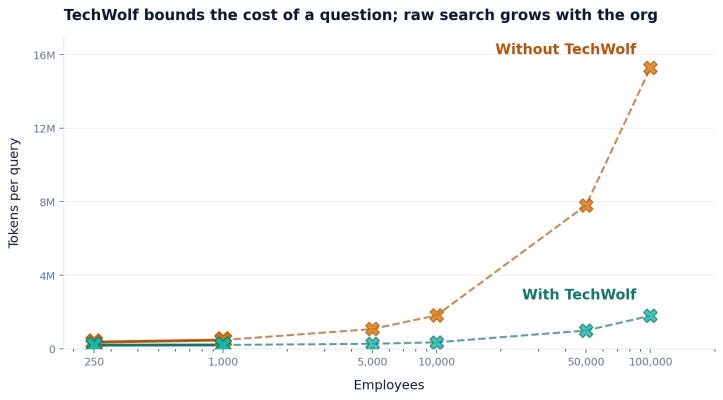
At 250 people, raw agentic search cost 50% more per question. At 1,000 people, 129% more. Projected to 100,000 people, the gap widens to almost an order of magnitude. The agent without a context layer has no way to scope its search ahead of time, so it crawls. As the org grows, so does the crawl.
What a context graph actually is
A context graph is a structured representation of your data, built once, kept fresh, and optimized for the kinds of questions agents ask. For workforce data, that’s a graph of people, skills, projects, training, and roles, with the relationships pre-computed. When the agent asks “who has experience with X,” it isn’t searching through millions of unstructured records, but rather traversing something that already knows the answer.
The principle generalizes. Whatever your enterprise data is, codebase, contracts, customer history, claims, agents on top of it need a layer between the raw source and the language model. Without one, you’re paying the LLM to do indexing work at runtime, on every query, against the entire org.
Why this matters more on workforce data
Token cost is the easy part of the story. For workforce data, the rest matters just as much.
Consistency. When an agent answers “who could lead this project,” the answer should be the same on Tuesday as it was on Monday, given the same underlying facts. A raw-search agent retrieves a different slice of the data each run, and the LLM stitches together a different rationale. A context graph gives the agent the same view every time. Decisions become reproducible.
Explainability. A skill profile inferred from “the agent found something that looked relevant” is not a defensible answer when an employee asks why they weren’t shortlisted. A skill profile traced to specific projects, completed training, and roles held is. The graph is the audit trail.
Fairness. Workforce decisions are a regulated category, high-risk under the EU AI Act and scrutinized everywhere else. In essence, you need to be able to demonstrate that the same logic applied to everyone. Raw agentic search is unauditable by design. You can’t show a regulator a reasoning chain that could be drastically different the next run.
The architecture choice
I’ve written before about why we only process workforce data our customers already own. First-party data, structured into a context graph, is the foundation that holds up when you start putting agents on top of it at enterprise scale. It costs less, holds quality, and produces decisions you can actually defend.